Are WPC doors a cost-effective alternative to timber? The answer depends on the whole service life, not only the purchase price. A WPC door may cost more initially than a basic timber door. However, it usually needs less repainting, sealing, and moisture protection. That matters in humid Chinese cities, where rain can darken timber edges and swell unprotected frames.
Grand View Research estimated the global wood-plastic composites market at approximately USD 7.1 billion in 2023. It also projects continued growth through 2030, supported by construction and demand for durable materials. Freedonia’s industry research similarly identifies moisture resistance, low maintenance, and material consistency as important WPC advantages. These reports support market confidence, but they do not prove that every WPC door saves money.
Installation quality changes the calculation. Poorly fitted WPC panels can expand under heat, stress hinges, or produce uneven gaps. Timber can also perform well when properly dried, coated, and maintained. Sometimes, it remains the better choice.
Dr. Michael Carus, founder of nova-Institute, has stated, “Bio-based does not automatically mean sustainable.” His warning applies here. WPC doors may contain recycled polymers and wood fibers, but buyers should check recycled content, warranty terms, repairability, and end-of-life options. A cheap door with weak hardware is not economical.
A fair comparison should measure purchase price, installation, maintenance, energy performance, expected lifespan, and replacement risk. For apartments, bathrooms, and coastal buildings, WPC can offer practical value. For premium interiors, responsibly sourced timber may provide stronger visual appeal and easier repair. The most credible answer is conditional: WPC doors can be cost-effective, but only when their durability matches the building’s climate and daily use.
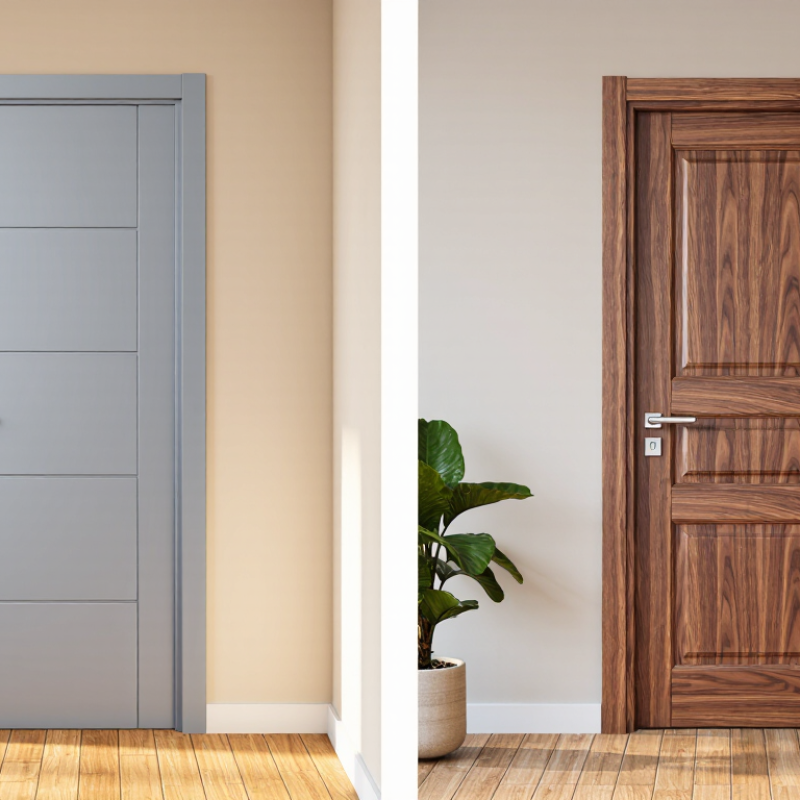
Are China WPC Doors a Cost Effective Alternative to Timber?
WPC Door Composition: 0.6–1.4 g/cm³ Density and Polymer-Wood Ratios
WPC doors combine wood fibre, thermoplastic polymer, pigments, and stabilisers. Their density commonly ranges from 0.6 to 1.4 g/cm³. The exact figure depends on fibre content, foaming, and pressing conditions. Industry technical reviews and ASTM D7031 guidance show that WPC performance must be judged through density, moisture absorption, bending strength, and thermal movement. A typical formulation may contain 30–70% wood fibre and 30–70% polymer by mass. Higher polymer content usually improves moisture resistance. Higher wood content can reduce material cost and create a more timber-like surface.
The USDA Forest Products Laboratory’s Wood Handbook reports wide density differences among timber species. Softwoods may remain below 0.6 g/cm³, while dense hardwoods can exceed 0.8 g/cm³. WPC therefore does not automatically cost less. It can reduce repainting, swelling, and replacement work in humid entrances. However, poor edge sealing or unstable additives may create disappointing results. That matters more than a low quotation. A door with 1.2 g/cm³ density may feel solid, yet its hinges and frame still require correct installation.
Tips: Request the density test method, polymer-wood ratio, water-absorption data, and screw-holding results. Compare the complete installed cost, not only the panel price. Ask for ageing or weathering evidence. Certification helps, but it cannot replace careful site inspection. Timber remains competitive when local species, skilled labour, and dry conditions are available. WPC becomes more persuasive where moisture exposure and maintenance costs are persistent concerns.
| Data Dimension | WPC Door Material | Solid Timber Reference | Cost-Effectiveness Implication |
|---|---|---|---|
| Primary composition | Wood flour or wood fiber combined with a thermoplastic polymer, commonly PVC, polyethylene, or polypropylene, plus additives and pigments. | Natural wood consisting mainly of cellulose, hemicellulose, lignin, and a small amount of extractives. | WPC offers more controllable and uniform material properties, while timber provides a natural structure and appearance. |
| Typical polymer-to-wood ratio by mass | Common formulations range from approximately 30:70 to 70:30 polymer-to-wood. A balanced formulation is often close to 50:50. | Not applicable; timber is not manufactured from a polymer-wood blend. | Higher polymer content generally improves moisture resistance and processing stability; higher wood content can increase stiffness and wood-like appearance. |
| Representative formulation bands |
Wood-rich: 30% polymer / 70% wood Balanced: 50% polymer / 50% wood Polymer-rich: 70% polymer / 30% wood |
Species and moisture condition determine density, hardness, and dimensional stability. | The selected ratio should match the intended exposure, required rigidity, surface finish, and manufacturing process. |
| Density | Approximately 0.6–1.4 g/cm³, depending on polymer type, wood content, additives, foaming, and internal structure. | Common dry-density values are roughly 0.3–1.0 g/cm³, although some dense hardwoods can exceed 1.0 g/cm³. | Density alone does not determine door quality; core construction, reinforcement, fasteners, and hinge design are also important. |
| Moisture response | Generally lower water absorption and swelling than untreated wood, although exposed cut edges and poorly sealed interfaces can still absorb moisture. | Hygroscopic; it absorbs and releases moisture, which can cause swelling, shrinkage, warping, or splitting if not properly sealed and installed. | WPC can reduce moisture-related maintenance in humid or wet locations, subject to proper edge and hardware detailing. |
| Surface maintenance | Usually requires routine cleaning; repainting or resealing is often less frequent than for exposed timber, depending on the surface coating and UV exposure. | Frequently needs periodic painting, staining, sealing, or repair, especially outdoors or in high-humidity environments. | Lower recurring maintenance can improve total ownership cost even when initial purchase prices are similar. |
| Thermal and dimensional behavior | Polymer-based WPC can expand more with temperature changes than timber; adequate installation gaps and suitable reinforcement are necessary. | Movement is mainly related to moisture content and grain direction; kiln drying and correct detailing reduce movement. | Installation quality is critical. Savings may be lost if clearances, reinforcement, or hardware specifications are inadequate. |
| Resistance to insects and decay | The polymer matrix is not a food source for termites, but wood particles, moisture, joints, and surrounding structures still require appropriate detailing. | Susceptibility varies by species, moisture level, preservative treatment, and exposure conditions. | WPC may reduce treatment and repair requirements in demanding environments, but it is not automatically maintenance-free. |
| Fire performance | Depends strongly on polymer type, additives, door construction, and tested assembly. A fire rating must be supported by a recognized test report. | Combustible; performance depends on species, thickness, moisture, protective treatments, and the complete door assembly. | Material selection should follow local fire-code requirements rather than price comparisons alone. |
| Indicative cost drivers | Polymer grade, wood-fiber content, additives, extrusion or molding method, surface film, reinforcement, hardware, order quantity, and shipping. | Species, grade, moisture content, machining, knots, treatment, finishing, scarcity, and local availability. | A fair comparison should include purchase price, installation, maintenance, expected replacement, and transport—not material price alone. |
| Overall suitability | Often suitable for humid interiors, utility areas, bathrooms, and projects seeking consistent dimensions and reduced surface maintenance, provided the complete door system is properly tested. | Suitable where natural appearance, repairability, traditional detailing, or species-specific structural and aesthetic properties are priorities. | WPC can be cost-effective over the service life in moisture-prone applications, while timber may remain more economical for dry environments or projects prioritizing natural wood. |
Note: WPC density and polymer-to-wood ratios vary by formulation and door construction. The ranges shown are representative technical ranges, not a specification for every product. Actual cost effectiveness depends on local prices, environmental exposure, installation details, and verified performance testing.
Supplier quotations often range from RMB 260–520 per square metre. For a 900 × 2,100 mm interior door, this is an indicative range. Hardware, installation, painting, and export packing may be excluded.
Engineered timber doors commonly cost RMB 380–800 per square metre. Solid timber may exceed RMB 800–1,800 per square metre. The lowest headline price may not represent the lowest project cost.
A finished WPC surface can reduce painting work and labour. That saving may narrow the price difference. Sometimes, not always. Installation quality still affects the final budget.
Request identical thickness, core density, surface finish, and moisture rating. Check whether the price includes the frame and architrave. Compare complete door sets, not panels alone.
It may require stronger hinges, edge protection, or better installation. Moisture resistance depends on the formulation and fitting quality. The comparison is imperfect.
Ask for the recycled percentage, material source, and calculation method. Production batches can contain different feedstock mixtures. Attractive wording is not enough.
Reliable data may cover materials, factory energy, transport, installation, maintenance, and disposal. Check the declared boundaries, functional unit, and data year. Numbers need context.
No. An ISO 14025 declaration structures life-cycle information. It does not automatically prove a low-carbon product. Independent verification and transparent background data remain important.
Include repairs, repainting, replacements, waste, maintenance, and disposal fees. Timber may cost more initially but allow simpler repairs. WPC may reduce repainting, yet durability varies.
Are WPC doors a cost-effective alternative to timber? This article examines the question through material composition, pricing, long-term performance, and environmental impact. It explains how WPC doors combine wood fibres and polymers, with density typically ranging from 0.6 to 1.4 g/cm³, and how different polymer-to-wood ratios influence strength, weight, moisture resistance, and price. A China-focused cost comparison evaluates WPC and timber doors per square metre, providing a practical starting point for buyers and project planners.
The analysis also considers ten-year lifecycle costs, including cleaning, maintenance, repairs, and possible replacement. Performance is assessed through moisture absorption, thermal U-values, and relevant EN 14351-1 requirements, helping readers compare durability and energy-related characteristics. Finally, the article reviews environmental factors such as recycled content, carbon accounting, and ISO 14025 environmental product declarations. Overall, WPC doors may offer stronger value where low maintenance, moisture resistance, and service life outweigh the initial price difference, but the best choice depends on specifications, installation conditions, and verified product data.

 ScotiaFire Doors