Industrial doors near tanks, refineries, and chemical process areas face more than weather and daily traffic. They may encounter vapor, heat, pressure, corrosion, and repeated impact. NFPA’s Fire Loss in the United States During 2022 reported approximately 1.5 million fires and more than 3,700 civilian fire deaths. These figures do not describe doors alone, but they show why passive protection deserves careful engineering.
What makes a door "explosion-proof" or "tank-grade"? The answer is not a heavy steel panel or a persuasive product label. In hazardous locations, NFPA 70, especially Articles 500 through 506, classifies environments by gases, vapors, dusts, and fibers. IEC 60079 standards add internationally recognized requirements for equipment used in explosive atmospheres. A credible door specification should identify its test method, pressure rating, fire rating, hardware, seals, and installation limits.
The ten features in this guide examine those details closely. Expect reinforced frames, controlled closing, non-sparking components, tested gaskets, corrosion-resistant finishes, and reliable anchoring. Some systems also include vision panels, emergency access, and documented blast performance. Not every “tank-grade” door provides the same protection. That phrase is often commercial, not a universal certification.
Small differences matter.
A door can look industrial yet fail at the frame, threshold, or hinge. Real-world reliability also depends on maintenance, alignment, and correct site classification. This guide therefore combines manufacturer practice, recognized standards, and practical inspection points. It also questions assumptions where evidence is limited. That is important, because a confident label cannot replace tested performance, qualified installation, and a documented risk assessment.
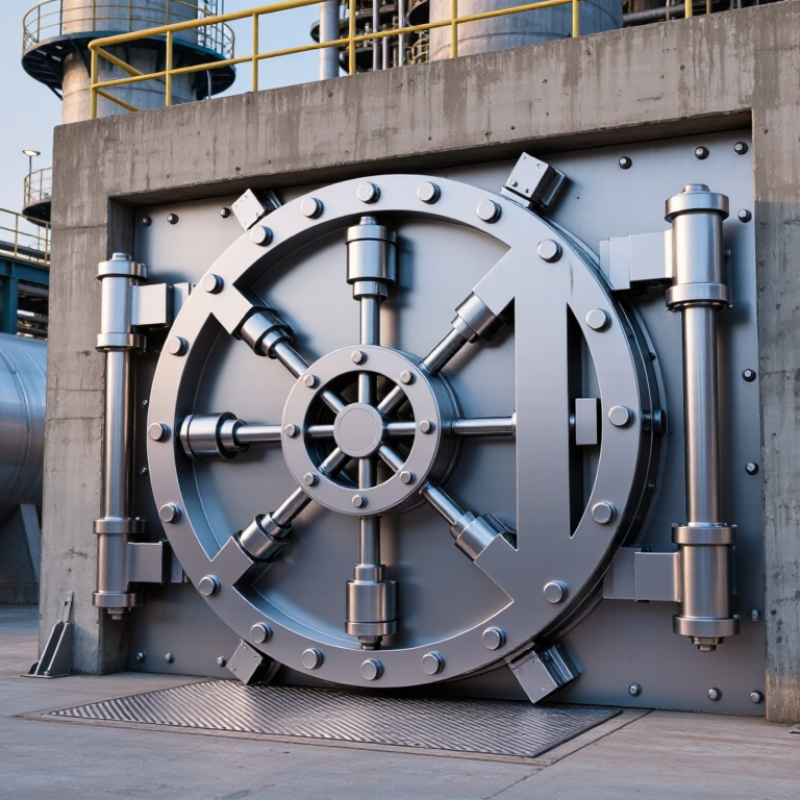
Tank-grade doors in hazardous areas must be selected by classified risk, not by appearance alone. Under ATEX, Zone 0 means an explosive gas atmosphere exists continuously or for long periods. Zone 1 indicates a likely occurrence during normal operation. Zone 2 covers gas that is unlikely, and brief when it appears. These distinctions influence door construction, seals, hardware, and installation controls. Small gaps matter.
For NEC Class I locations, the hazard involves flammable gases, vapors, or liquids. Class I, Division 1 generally reflects normal or frequent hazardous conditions. Division 2 describes abnormal release or containment failure. NEC Zone 0, 1, and 2 terminology can also apply, but the adopted system must be verified with the project authority. A qualified engineer should check certification, temperature rating, pressure behavior, and gasket compatibility. Do not assume equivalence.
Useful features include continuous compression seals, corrosion-resistant hinges, robust latching, controlled closing, and frames that limit flame paths. Vision panels, cable penetrations, and thresholds need equal attention. A strong door leaf cannot compensate for a weak frame. In practice, dust, paint buildup, and misalignment can reduce sealing performance. That detail is easy to miss. Selection should follow the site classification drawing, equipment certificate, ventilation design, and maintenance plan. Terminology is not always consistent, so records deserve a second review before purchase.
Top 10 Features of Explosion Proof Tank Grade Doors: Construction Materials That Resist Corrosion
Tank grade doors often face salt spray, cleaning chemicals, humidity, and process vapors. In these conditions, 316 stainless steel offers dependable structural durability. Its chromium and nickel content support passive surface protection. The addition of about 2% molybdenum improves resistance to pitting and crevice corrosion, especially around welds and hardware. Corrosion starts quietly. Inspectors may first notice tea-colored stains near hinges, drains, or fasteners.
From practical site inspections, smooth 316 surfaces are easier to wash and monitor. Properly finished welds reduce residue traps. Rounded corners also limit moisture collection. Gaskets should match the operating environment, because strong metal cannot compensate for a damaged seal. Door frames need compatible fasteners and careful drainage. Details matter. A mixed-metal assembly can create galvanic corrosion when moisture remains between dissimilar parts.
However, 316 stainless steel alone does not make a door explosion-proof. The complete design must control ignition risks, pressure behavior, sealing, bonding, and certified hardware selection. Qualified engineers should verify the assembly for its intended tank area and hazardous classification. A common mistake is treating molybdenum content as a complete solution. It is helpful, not magical. Concentrated chemicals, stagnant liquid, and poor maintenance can still damage the surface. Regular inspections should record discoloration, pitting depth, gasket condition, hinge movement, and fastener tightness. That assumption fails. Material selection must work together with testing, installation quality, and maintenance discipline.
Construction Materials: 316 Stainless Steel and 2% Molybdenum Corrosion Resistance
Why 316 Stainless Steel Is Used
316 stainless steel contains chromium and nickel for passive corrosion protection, while approximately 2–3% molybdenum improves resistance to pitting and crevice corrosion in chloride-containing environments. These properties support durable tank-grade door construction, especially where moisture, salts, chemicals, and frequent cleaning are present. Actual door performance also depends on gasket selection, weld quality, hardware, surface finish, and compliance with the applicable explosion-protection standard.
Sealing quality determines whether an explosion-proof tank door protects reliably. IEC 60529 defines IP66 as dust-tight protection and resistance to powerful water jets. That rating matters near washdown zones, where moisture can attack hinges, locks, and electrical interfaces. NEMA 4X adds protection against water, dust, and corrosion. However, IP66 and NEMA 4X are enclosure ratings, not complete gas-tight guarantees.
A properly designed gasket should maintain continuous compression around the door frame. Closed-cell materials reduce leakage paths and resist moisture absorption. Gas-tight gaskets also help limit vapor migration during normal operation. Yet gasket performance can decline from heat, ultraviolet exposure, chemical contact, or repeated opening. Field inspections often find uneven compression near corners. Small defects become serious over time. The door may still look secure.
Tips: Check gasket hardness, compression, and joint alignment during every scheduled inspection. Follow the manufacturer’s tested replacement method, not guesswork. The 2024 Global Industrial Safety Equipment Market analysis identifies enclosure integrity as a major selection concern in hazardous processing environments. Standards remain more dependable than marketing claims. Verify the actual test documents for IP66, NEMA 4X, and gas-tight performance. A practical design should also include corrosion-resistant hardware, protected hinges, and a clear maintenance record. Even strong seals need periodic review.
In tank-farm inspections, door performance often depends on details overlooked during purchasing. A 90-minute fire rating indicates tested endurance, not automatic blast protection. NFPA 80 requires fire door assemblies to maintain labeled integrity under controlled furnace testing. The rating usually covers flame passage and temperature limits. It does not define pressure resistance.
That distinction matters. NFPA reported approximately 1.39 million U.S. fires in 2023, causing nearly $22.2 billion in property damage.
Tank facilities need more than a fire label. Blast specifications should identify peak reflected pressure, impulse, load duration, and allowable deformation. UFC 3-340-02 provides pressure-time methods for protective design, while project engineers should verify site-specific hazards. A suitable door may use a reinforced steel leaf, mineral insulation, compression seals, and multi-point latching. Hinges and frames require equal attention.
Details decide. Pressure ratings should be stated in psi or kPa, with test evidence and mounting conditions.
A door tested alone may perform differently inside a flexible wall. That weakness is easy to miss.
Field teams should inspect anchor bolts, seals, closing speed, and latch engagement regularly. I have seen acceptable doors fail operational checks because corrosion restricted the hinges. The 90-minute label remained valid, but the installation needed correction.
Top 10 Features of Explosion Proof Tank Grade Doors
Reliable tank grade doors need more than heavy steel and tight seals. Their safety depends on verified design, correct installation, and disciplined maintenance. IEC 60079 requirements help evaluate equipment used in explosive atmospheres. NFPA 70 guides electrical installation and hazardous-location practices. Neither standard should be treated as a decorative certificate.
Look for sealed frames, strong hinges, conductive hardware, corrosion-resistant finishes, and reliable bonding points. Door assemblies should match the classified area, pressure conditions, and surrounding chemicals. Certification documents must identify the tested configuration. Small changes can matter. Replacing a latch or gasket without approval may affect protection. Annual safety inspections should check seals, hinges, fasteners, grounding continuity, labels, and surface damage. Inspectors should record measurements, photographs, repairs, and unresolved concerns. In real facilities, paperwork is often the weakest feature.
Tips: Keep a maintenance log beside the access point. Clean gasket surfaces before inspection. Do not paint over identification labels. Test bonding with suitable instruments, not visual judgment alone. Review the area classification whenever processes change. A door may look perfect and still fail a continuity test. That uncomfortable possibility deserves attention. Qualified personnel should follow the applicable edition of each standard and the equipment’s certified instructions.
| No. | Key Feature | Technical and Safety Requirement | Relevant Standard or Design Basis | Verification and Maintenance |
|---|---|---|---|---|
| 1 | Correct Hazardous-Area Suitability | The complete door assembly, electrical accessories, and associated equipment should be suitable for the classified location, gas or dust group, temperature class, and ambient conditions. | IEC 60079-0; IEC 60079-14; NFPA 70 Articles 500–506 | Confirm the area classification and equipment markings during initial installation and whenever the process, material, or location classification changes. |
| 2 | Documented Ex Certification | Certification documents should identify the protection concept, equipment group, EPL or zone suitability, temperature class, ingress-protection rating, and permitted installation conditions. | IEC 60079-0; IEC 60079-1; IEC 60079-7, where applicable | Check certificates, marking plates, installation instructions, and any certificate-specific conditions. Do not treat a general “explosion-proof” description as sufficient evidence of compliance. |
| 3 | Robust Enclosure and Flame-Path Integrity | Where a flameproof Ex d design is used, enclosure joints, covers, threaded entries, and flame paths must remain within the certified design tolerances and free from damage, contamination, or unauthorized alteration. | IEC 60079-1; IEC 60079-17 | Inspect joints and fasteners for impact damage, corrosion, distortion, missing parts, or evidence of filing, grinding, drilling, or other modification. Use only approved repair methods. |
| 4 | Positive Self-Closing and Secure Latching | The door should close fully, latch reliably, and remain secured against vibration, pressure differences, and accidental opening. Any closer or latch used in a classified area must be suitable for the location. | IEC 60079-14; NFPA 70 Article 110.3(B); applicable building and fire codes | Test the closing and latching action at least annually and after repairs. Replace worn springs, latches, hinges, or closers with components permitted by the approved design. |
| 5 | Certified Seals and Gaskets | Gaskets, seals, and compression elements should be compatible with the stored or processed substances, temperature range, ultraviolet exposure, and pressure conditions. They must not compromise the certified protection concept. | IEC 60079-0; IEC 60079-14; manufacturer’s certified documentation | Check for cracking, flattening, hardening, swelling, cuts, chemical attack, or loss of compression. Replace damaged sealing elements with approved equivalents and record the work. |
| 6 | Bonding and Grounding Provision | Metallic doors, frames, panels, and conductive accessories should be bonded where required to prevent dangerous potential differences and static discharge. Continuity must not rely on painted or corroded contact surfaces. | NFPA 70 Article 250; IEC 60079-14; IEC 60079-17 | Inspect bonding conductors, terminals, and contact points for looseness, corrosion, paint interference, or mechanical damage. Verify continuity using a documented test method appropriate to the installation. |
| 7 | Ingress and Environmental Protection | The door and frame should provide the required protection against water, dust, corrosive atmospheres, washdown, and weather exposure. The IP rating must match the installation requirements. | IEC 60079-0; IEC 60529; NFPA 70 environmental-location requirements | Inspect drainage paths, thresholds, seals, drain plugs, coatings, and enclosure surfaces annually and after severe weather or washdown events. Remove debris without damaging certified surfaces. |
| 8 | Compatible Hardware and Cable Entries | Hinges, bolts, handles, viewing panels, cable glands, conduit fittings, and penetration seals must be compatible with the door’s protection method and installed according to the certified instructions. | IEC 60079-1; IEC 60079-14; NFPA 70 Articles 500–506 | Check for missing or substituted hardware, loose fittings, damaged threads, improper conduit seals, and open unused entries. Maintain all unused openings with approved stopping or sealing components. |
| 9 | Clear Marking and Safe Access | Warning labels, Ex markings, electrical hazard signs, door identification, and access restrictions should remain visible. The door must not obstruct required emergency egress, ventilation, or access to safety equipment. | IEC 60079-0 marking requirements; NFPA 70 Articles 110 and 500–506; applicable fire and building codes | Verify that labels are legible and securely attached. Confirm that walkways, exits, operating clearances, and emergency access routes remain unobstructed. |
| 10 | Documented Annual Safety Inspection | A competent person should inspect the door assembly, protection features, electrical accessories, structural condition, and operating performance under a documented hazardous-area maintenance program. | IEC 60079-17; NFPA 70 maintenance principles; site risk assessment and AHJ requirements | Perform a documented inspection at least annually when required by the site program, risk assessment, authority having jurisdiction, or local regulation. Record defects, corrective actions, test results, dates, and inspector qualifications. |
Important: IEC 60079 and NFPA 70 address hazardous-location equipment selection, installation, inspection, and maintenance; they do not automatically certify every door marketed as “explosion-proof.” The required protection method, area classification, certification conditions, inspection interval, and acceptance criteria must be confirmed for the specific installation by the responsible electrical professional and the authority having jurisdiction.
It resists salt spray, humidity, cleaning chemicals, and process vapors. Chromium and nickel help maintain passive surface protection. The steel remains strong during repeated cleaning.
Molybdenum improves resistance to pitting and crevice corrosion. It helps around welds, hinges, drains, and fasteners. It is helpful, not magical.
No. The complete assembly must control ignition, pressure, sealing, bonding, and hardware selection. Qualified engineers must verify the intended hazardous area. Material choice alone is not enough.
IP66 indicates dust-tight protection and resistance to powerful water jets. NEMA 4X indicates protection from water, dust, and corrosion. Neither rating automatically proves gas-tight performance.
Inspect compression, hardness, joint alignment, and surface condition. Look closely at corners. Heat, ultraviolet exposure, chemicals, and repeated opening can weaken gaskets.
Record discoloration, pitting depth, gasket condition, hinge movement, and fastener tightness. Check bonding continuity with suitable instruments. A perfect-looking door may still fail testing.
Dissimilar metals can cause galvanic corrosion when moisture remains between them. Use compatible fasteners and provide careful drainage. Small trapped droplets matter.
Documents should identify the tested door configuration and applicable hazardous-area requirements. Unapproved latch or gasket changes may reduce protection. Paperwork is sometimes the weakest feature.
What makes a door "explosion-proof" or "tank-grade"? It is the combination of engineered construction, certified protection, and reliable performance in hazardous environments. These doors are designed for explosion-hazard areas classified under ATEX Zones 0–2 and NEC Class I locations, where flammable gases or vapors may be present. Their construction commonly uses 316 stainless steel with approximately 2% molybdenum to improve corrosion resistance in demanding industrial conditions.
A tank-grade door also requires effective sealing and structural strength. IP66 and NEMA 4X protection levels help defend against dust, water, and corrosive exposure, while gas-tight gaskets limit leakage through the enclosure. Fire performance may include a 90-minute rating, supported by pressure-resistance criteria suited to the installation environment. Proper certification should align with IEC 60079 and NFPA 70 requirements, and annual safety inspections are essential to verify seals, hardware, grounding, and overall operational integrity.

ScotiaFire Doors